Analyze to Inspire Action or Answer Desperation
Last modified at Jul 28, 2024
Also about Power and not to have junior mindset
Hello there!
Q2 has already passed, and my entire company is as busy as ever, ready to face Q3 and Q4. But I believe it’s a good thing to be able to pause a little and write about things that I find interesting throughout the weeks.
In this newest edition of Data and Decision, we talk about how analysis should inspire stakeholders to take action or fulfill their aspirations. I also shared an interesting X thread about Power and its impact on us data people. And finally, a post from one of my idols (and a couple of other things).
Alright then, let’s jump to the main course.
Inspire Action or Answer Desperation
One of the highest ROI activities I’ve undertaken this year is joining Data Twitter, both in my country and internationally. The other day, one of the accounts I follow posted something about how rare it is to see a 10X Data Analyst, unlike 10X Engineers whom we see mentioned in many blog posts.
Multiple discussions broke out, and one person mentioned, “Yeah, it is rare to see a 10X Data Analyst because it depends on how receptive our stakeholders are to our analysis.” I then joined in and offered my two cents (in Bahasa). If translated, it would be something like this:
“I’ve seen this somewhere in a Discord forum, but to create analysis that effective you need to either inspire the stakeholder to take action or try to fulfill their desperation “What else that we should do, folks?”
Fortunately for me, with this Tech Winter going, there are so much desperation nowadays, ha!”
Apparently, one of my friends saw that tweet and joked how true the statement is, but it’s often missing from discussions within data teams. I myself rarely ask, “Okay, does this analysis inspire them to take action, or is there any distress that it will address?” And I consider myself a “stakeholder über alles” kind of guy.
So why isn’t this intuitive for us?
Maybe we can change the way we frame this. If we change the word “analysis” to “advice,” it all makes more sense. If you give advice to someone when they don’t need it, you need to make it interesting so it’s inspiring to them. But if they’ve already faced a problem and come to you for advice, they’re more receptive to new perspectives.
This conversation becomes more interesting when we consider that we can package our advice to be more useful or tailor it to the person who will receive it. Saying “I think you need to expand to Asia” is inferior to advice such as “You know Indonesia has a big market for your product, right? The government has created tax incentives that will expire this year. You need to enter now.” And giving advice like this would be confusing for the average person, but valuable for your international friends who have businesses.
If you try to remember only one thing from this short post, try this: ask yourself, “Will this inspire action, or address a pressing need?” every time we do analysis.
Be Close to Power
The other day Cedric Chin, one of my favorite author, posted this in his account.
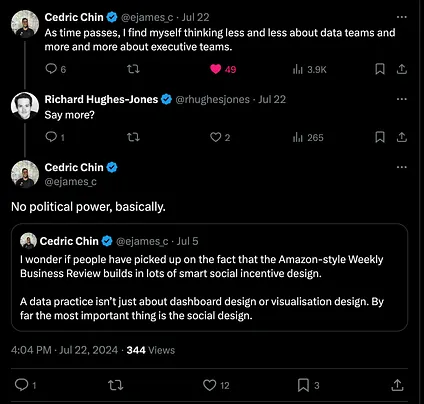
It’s a controversial topic, and I’m not really sure if readers of this newsletter want to talk about this one — although I find it very valuable.
The background of this topic is pretty long (I would suggest exploring that thread and reading all of the posts and replies), but to summarize: the uncomfortable reality that any data person needs to face is that being ‘data-driven’ mostly comes from the top, from people who have ‘Power’. Cedric himself has talked about this separately in this post, where he discussed ways to become more metrics-driven.
A data leader once told me that he believed there were only two ways you could change a company culture to become more metrics driven: “either the CEO leads the charge, changing executive behaviour from the top down, or every leader who isn’t data driven gets kicked out of the company.” (emphasis added)
I agree with the entire argument (however painful it is), and if you also agree, I suspect the next important step is for us to focus on ‘Who are those that have Power?’
Abhi Sivasailam came up with perhaps the most succinct explanation for this term.
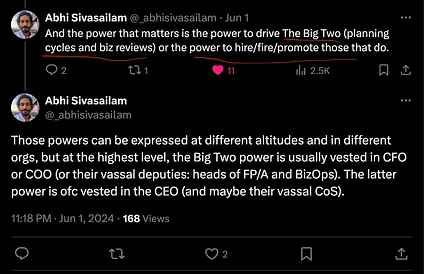
It’s so good that I think I should rewrite it here again: “Power that matters is the power to drive The Big Two (planning cycles and biz reviews) or the power to hire/fire/promote those that do”.
So, basically control of budget and promotion (or meeting, eh?)

Does the ability to start weekly metrics meeting includes as one of the Power? Afraid not:(
I will the first person to admit that I still haven’t worked out the 2nd or 3rd implication if we use this ‘Power’ definition. Does your first move as data leader is to assess which exec that more friendly to data? How about try to made friend with their vassals first? I’m sure we had valuable lesson for this.
Your Data Team Doesn’t Need to be Fancy
This post written by data leader that I really looked up to, Lindsay Pettingill. Lindsay give her reaction about certain Reddit post that got viral couple months ago.
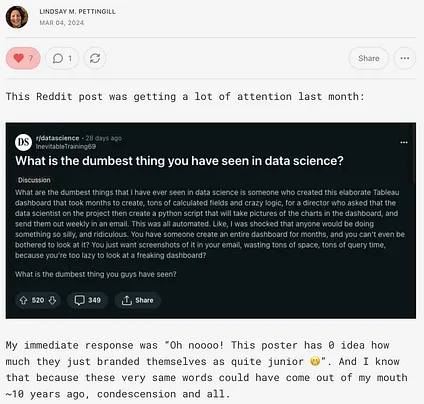
I saw that same Reddit post myself and remember it caused quite a stir in the data community. Lindsay gives a perspective that I feel is really worth its weight in gold for us data people.
To be blunt: no one except other data scientists care about how you did something.
Arguing that a dashboard took time to build and has “ tons of calculated fields and crazy logic” (as the poster does above) does not matter to a VP! What matters is that your work helps her make a decision. What the Data Scientist above did not hear is that Tableau is preventing the VP from making a decision. The VP just doesn’t have the time. Why? First, have you ever used Tableau? I wouldn’t make time for it either!
Your Data Team doesn’t need to be fancy — Lindsay Pettingill
One of the things that makes me quite sad is that the mindset of ‘Can’t you just open the dashboard? Why do you need us to send you an email?’ is so prevalent in the data world.
In the past, I’ve talked with a bunch of analysts in a forum who worked in big companies. They boasted a lot about their data stack and how expensive it was (this was before the Tech Winter). I then tried to ask if they knew how many viewers per month their dashboards had (usually normal BI tools have this logging mechanism, to my knowledge). Or if they knew whether the dashboard was viewed consistently in weekly stakeholder meetings.
They gave me blank stares.
The story has a kind of happy ending though, don’t worry. I connected with them after that forum and we became friends. They sometimes chuckle when I mention this interaction with them. They’re really brilliant guys — and it also says a lot about this mindset, which can affect nearly everyone.
Others
- Excerpt from one of Luca Dellanna’s book, “Winning Long-Term Games”
“The key to winning long-term games is to stop playing them as a succession of separate shor-term games.”
- How Github need to create their own search engine. The big data era isn’t over.
- Excerpt from “Working with AI: Two paths to prompting” by Ethan Mollick
“Structured Prompting is about turning the AI into a tool that does a single task well in a way that is repeatable and adapts to its user. Since the AI is not always built to do this, it will take “experimentation and effort to make a prompt work somewhat consistently (it is very hard to reach 100% consistency with LLMs). To start, you need a clear goal.”
- Tiago Forte on why we need to focuses more on personal knowledge management system
Your lack of a personal knowledge management system is costing you opportunities
See you in the next edition, folks